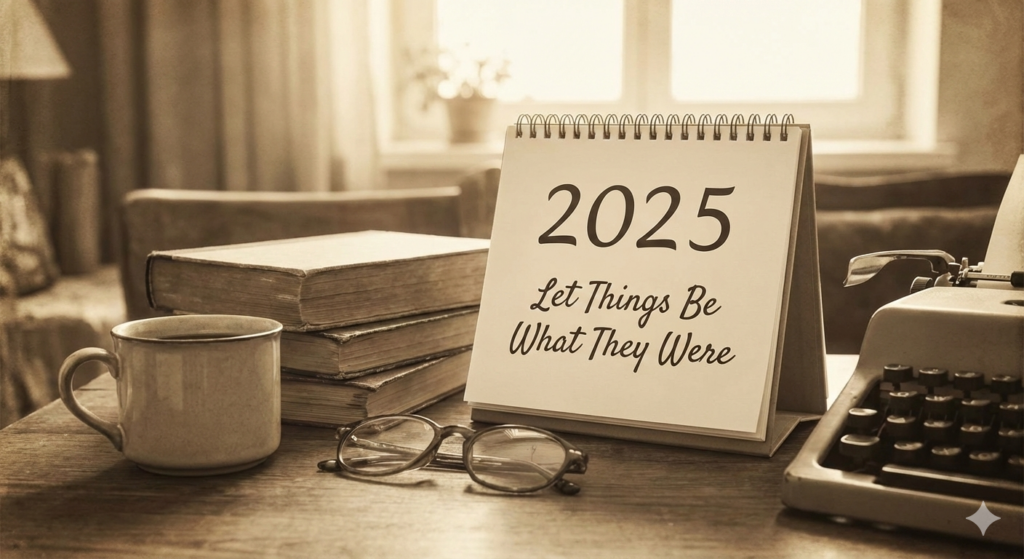
2025: Let Things Be What They Were
By the time 2025 wrapped itself up and quietly left the room, I realized something uncomfortable but honest: it ended better than I expected. Not in a fireworks-and-confetti way. More in a “huh… I didn’t spiral today” kind of way. Which, frankly, counts as growth.
When the year began, I couldn’t wait for it to be over. I remember thinking, let’s just get through this. I had already written its obituary in my head before February finished clearing its throat. And yet—annoyingly, beautifully—it refused to cooperate with my pessimism. It didn’t end how I imagined. It ended better.
Let me rewind.
When I started this blog, I had grand editorial visions. Monthly reflections. Clean timelines. A neat little archive of my emotional life. January and February behaved. They showed up, got documented, and then—like many of my plans—they watched me get distracted by something shinier. In my case, stories. Research. Writing rabbit holes that started with one question and ended three hours later with me Googling things like why humans name hurricanes at 2 a.m.
And that, it turns out, was the point.
Somewhere between researching theology, storytelling, and whatever intellectual itch I was scratching that week, I learned a few things.
First: I write better than I thought I did.
Second: religious writing—unexpectedly—rose to the top of what people engaged with most. Which surprised me, but also felt right.
And third: four people consistently read this blog, and I love them with my whole heart. Truly. In a world obsessed with numbers, clicks, and virality, there is something grounding about knowing exactly who you’re talking to. Cenacle may grow, but it also may not. And either way, I’m learning to love the work itself and let the rest sort itself out.
The year itself was long. The first half was… not gentle. Too many moving pieces, too much noise, too little rest. But then June happened. Or rather, I happened to June. I changed my environment after eight years in one place, and I don’t say this lightly: it changed my life. There’s research behind this, by the way. Environmental psychology tells us that our surroundings directly affect our nervous systems. Turns out, your brain notices when you stop surviving and start existing.
For the first time in a long time, I can say I love my job. It feels like a second home. My anxiety—once a constant background hum—quieted. I sleep now. I lost weight without trying, something I hadn’t managed in five years. I don’t love the commute, which is how I know I’m healing, because I’m even considering moving closer to work. Past me would never.
Outside of that, I did what I do best: I consumed stories. A lot of them. Nearly 2,000 hours of reading time. Movies and series mostly from my couch, because peace has a very specific seating arrangement. I only made it to the theater three times—Captain America: Brave New World, Sinner, and Thunderbolts—and honestly, that felt sufficient. I spent more time on YouTube than I care to admit, but we’ll call that cultural research.
And then, right at the end of the year, life surprised me again. I started writing plays and stories for a church. Which—if you had told me that at the start of 2025—I would have laughed, stared, and slowly backed away. Yet here I am, enjoying it, feeling oddly aligned, content in a way that doesn’t demand fireworks.
Of course, not everything followed through. There are hobbies and projects that began with enthusiasm and ended with… vibes. My bathroom vanity, for instance, has been doorless for months because I chose a paint color that had to be custom mixed, and that single decision was apparently enough to derail the entire project. This is, as the professionals say, an ADHD moment. I know the reward is there. I just cannot seem to walk toward it. Maybe I’ll paint it. Maybe I won’t. The vanity and I are in negotiations.
Which brings me to a thought I kept circling all year: humans anthropomorphize everything. We name our years. We say things like “2025 was kind to me” or “this season tested me.” We talk to our cars. We curse our laptops. Psychologists say we do this because it helps us process complexity and emotion. Assigning personality to abstract things gives us a sense of relationship and control. Cultures all over the world do it—Japan has tsukumogami, spirits for objects; ancient myths gave weather moods and motives; modern science says it’s empathy leaking into logic.
So yes, I’ve been talking about 2025 like it’s a person. But maybe that’s because it behaved like one. It started distant. It was difficult to trust. And then, slowly, it showed up for me in ways I didn’t expect.
The year was good. Not perfect. Not polished. But honest. And if there’s one thing I’m taking with me, it’s this: growth doesn’t always look dramatic. Sometimes it looks like sleeping better, writing more, and accepting that unfinished vanity doors do not define your worth.
And as I like to say at the end of every day, and now at the end of this year:
We will try again tomorrow.
