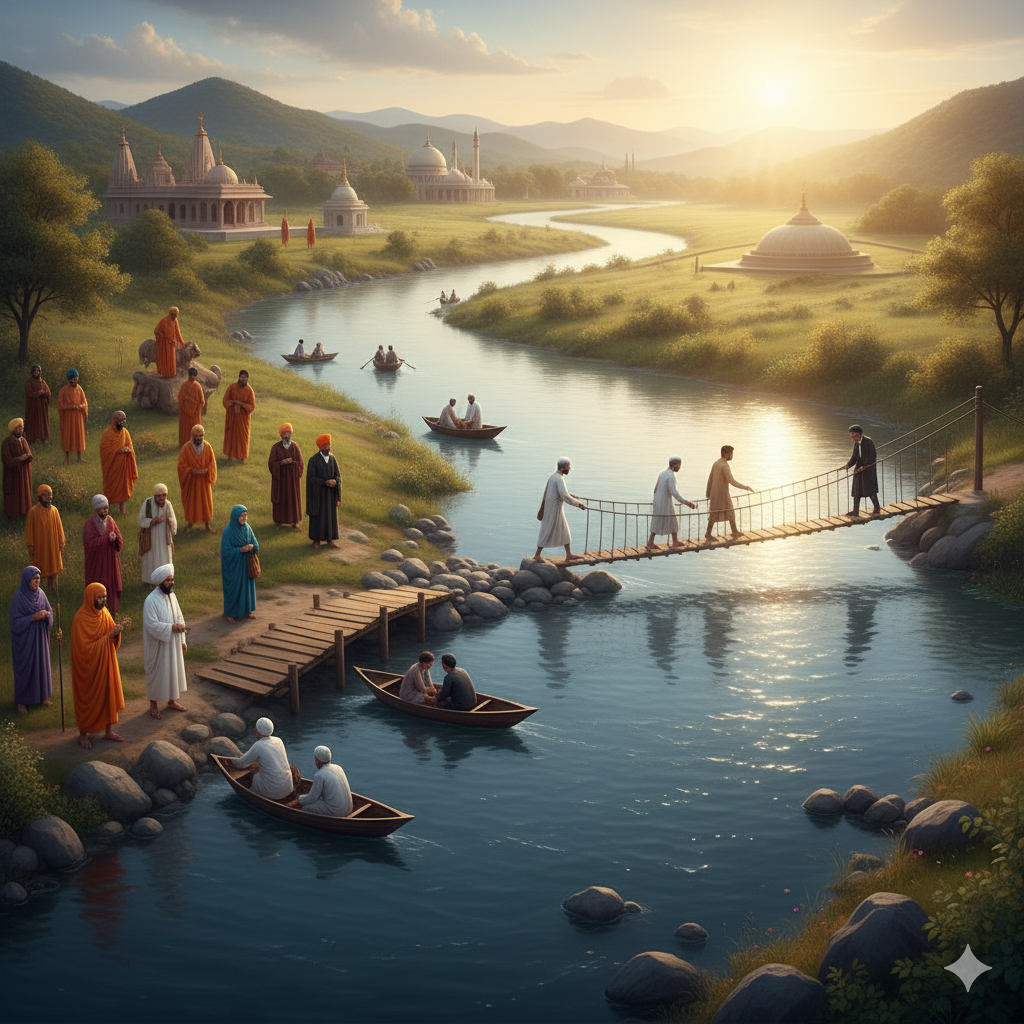
One River, Many Crossings
🌊 One River, Many Crossings: How the World’s Religions Try to Get to the Other Side
I was recently caught in one of those conversations that start with “Let’s just talk about religion for a second,” and before I knew it, we were three hours deep into a discussion that could have solved world peace if we weren’t all too busy quoting half-remembered Bible verses and mispronouncing “Confucianism.”
Somewhere in that caffeine-fueled chaos, I realized something: most people, even the passionately religious ones, don’t actually know what religion is.
We know the names. We know who prays where. But we rarely pause to ask the bigger, messier question:
“What actually makes something a religion and what kind of god (or no god) does it even have?”
So let’s talk about it. And to keep things interesting, let’s do it through a metaphor- a River.
Because life, belief, and confusion all flow the same way: wildly, relentlessly, and occasionally drowning people who didn’t read the map.
Fair Warning: This Is One Of My Longest Posts, So Grab A Coffee, A Snack, Or A Life Vest Because You’re Going To Need It.
🚣 The River of Life -and Everyone’s Trying to Cross
Imagine a wide, mysterious river deep enough to terrify you, beautiful enough to make you believe there must be something on the other side.
Every religion stands at its edge, trying to figure out how to cross.
✝️ The Theists: “God Will Build the Bridge”
Let’s start with the theistic crowd, the ones who believe there’s a personal God (or several) watching over things.
Christians say, “Relax. God built the bridge Himself -just have faith and walk across.”
Muslims say, “The bridge is there, but only if you follow the exact instructions Allah left in the manual.”
Jews say, “God gave us the blueprints centuries ago. Keep the covenant, maintain the bridge, and don’t get clever with shortcuts.”
Sikhs say, “There’s one God for everyone, and He built one solid bridge -no need for fifty toll booths.”
Hindus (well, some of them) say, “There are many bridges, some longer, some prettier, some very confusing, but all leading to the same ultimate shore -Brahman.”
For these groups, crossing the river is about Relationship -you trust the Builder. You obey the rules. You pray the bridge doesn’t collapse halfway through.
🪷 The Philosophers: “The River Isn’t the Problem -You Are”
Then come the non-theistic traditions, the ones with no personal god to pray to, but plenty of wisdom to share.
Buddhism says, “The river isn’t real in the way you think it is. Stop clinging, let go of your desire to cross, and you’ll realize there was never a river at all.”
Jainism says, “Careful, you might step on something living. Move gently, cross slowly, harm nothing.”
Confucianism says, “Everyone just stand in an orderly line, follow the moral code, and we’ll get across without chaos.”
Taoism says, “Why are you trying to cross? Flow with the river. Be the current, not the stone.”
No divine bridge-builders here, just the way, the path, the code. These are the Rule-Followers, not because they’re uptight, but because they see structure, order, and discipline as sacred.
Their version of salvation isn’t heaven, it’s harmony.
🤓 The Thinkers: “What If There Is No Other Side?”
And then you have the atheists and agnostics, the ones still standing at the riverbank with folded arms and a skeptical squint.
The Atheist says, “There’s no other side. It’s just water and physics. Swim if you must, but don’t pretend Poseidon’s helping you.”
The Agnostic says, “There might be another side, but since I can’t prove it, I’ll just set up camp here and keep an open mind.”
The Gnostic (not to be confused with Agnostic) says, “I’ve seen the other side, secret knowledge revealed! But it’s complicated, and you wouldn’t get it.”
So yes, Gnostic means I know, Agnostic means I don’t know, and Atheist means I don’t think there’s anyone to know.
Now, let me clear this up for you: the big five- Christianity, Islam, Judaism, Sikhism, and Hinduism are NOT gnostic. I know, I know,you thought they were. But they’re not. Gnosticism, which comes from the Greek word gnosis (meaning “knowledge”), was an ancient spiritual movement that believed salvation came through secret knowledge rather than faith, ritual, or moral living. Today, you could think of gnostic groups as a sort of spiritual “Secret Society” or certain New Age movements, the ones with the hidden keys to enlightenment tucked under velvet drapes.
💬 The Great Divide -and the Great Human Hobby of Disagreeing
Here’s the thing: even within the same religion, people still can’t agree on how to cross the same river.
Take Christianity.
We started with one bridge, the Roman Catholic one. Then one morning, someone in the East said, “Actually, I don’t like how you’re building it,” and boom – the Great Schism.
A few centuries later, Martin Luther wakes up one fine morning, nails a list to a door, and basically says, “You know what? I’m starting my own bridge project.”
By dinner, we had Lutherans.
By the weekend, we had Calvinists, Presbyterians, Methodists, Anglicans, Baptists, Pentecostals -honestly, it was like a holy version of Shark Tank.
And it’s not just Christianity.
Islam has Sunni and Shia.
Judaism has Orthodox, Conservative, and Reform.
Buddhism has Theravāda, Mahayana, and Vajrayana.
Even Hinduism’s got so many paths it could qualify as a spiritual theme park.
Humans disagree like it’s an Olympic sport.
If we all had to build one bridge together, someone would inevitably say, “I don’t like the colour of that plank,” and next thing you know –Denomination.
And that’s… okay. Really, it is. Disagreement is part of the design. Without it, belief would be dictatorship, not devotion.
⚠️ Cults, Churches, and the Search for Something More: When Desire Meets Danger
Religion itself is a sensitive conversation -one misstep and someone’s feelings get bruised, even if your intentions are pure. But the discussion can’t shy away from the uncomfortable truths: emotional, psychological, and even financial abuse happens in some churches, cults, and religious groups. Often, it’s fueled by over-the-top prosperity teachings, manipulative authority figures, or even physical coercion.
I’m not victim-blaming -far from it. What I’ve noticed is that many people caught up in these situations were looking for something: meaning, excitement, a miracle, a sign, or a change in their story. And when you step out of the familiar -the routine, the boring comfort of the faith you were raised in -in search of this, you’re vulnerable.
People born into Catholic, Baptist, Methodist, or Presbyterian traditions sometimes leave their church because they find it “boring” or “uninspiring,” yet they rarely know the doctrine themselves -only what they’ve heard. And that’s often where opportunistic, manipulative groups step in. They prey on those searching for connection or direction, not on those who already have a solid foundation.
This isn’t unique to one denomination or religion -abuse exists everywhere. The lesson? Be deliberate in your exploration. Change isn’t bad, and seeking something new isn’t inherently wrong, but do it slowly, do your research, understand the consequences, and have a contingency plan. Know when to stay, and more importantly, know when to leave.
And a note for the skeptics who think “common sense” alone can protect people: it’s rarely about ignorance. Scams and abuse often succeed because urgency, manipulation, and control are applied to your ability to analyze and discern. Even those who seem to have it all together can be taken advantage of. Experiencing it yourself is the only way to truly understand why warnings alone aren’t enough.
🙏 So, What’s the Point of All These Bridges?
Whether your path is lit by a divine builder or a moral compass, the truth is the same:
You can’t outsource your crossing.
Especially for Christians -and I say this lovingly, as one -we’ve become experts at delegating our salvation.
We hand the responsibility to our pastors, priests, prophets, and prayer warriors like they’re spiritual personal assistants.
But God doesn’t subcontract transformation. You have to pick up the hammer and build your own bridge of faith.
And please –Read Your Bible. Because half the “verses” people quote are not in there.
Here are some greatest hits that sound holy but are completely made up:
- “God helps those who help themselves.” (That’s Benjamin Franklin, not Jesus.)
- “Cleanliness is next to godliness.” (That’s from John Wesley -also not Jesus.)
- “Money is the root of all evil.” (Nope. It’s the love of money that is.)
- “This too shall pass.” (Actually, Persian poetry, not scripture.)
- “Heaven helps those who hustle.” (Okay, that one’s just Instagram.)
- “Spare the rod and spoil the child” (from a poem by Samuel Butler -carefully read the proverbs verse again)
🌞 Finding Your Way Across
Whether you’re walking the bridge, floating in the flow, or building a raft out of reason, here’s the truth nobody likes to admit:
All of us -believers, skeptics, monks, and meme lords -are staring at the same river.
We all sense there’s something beyond this side of life, something that makes it worth crossing, questioning, or surrendering to.
Some call it God.
Some call it Truth.
Some call it Peace, Order, or Love.
Whatever you call it, the journey is personal.
You don’t cross by committee. You cross by conviction.
🌊 Final Thought
So next time someone starts an argument about religion, don’t fight. Just smile and say:
“We’re all trying to get across the same river. Some are building bridges, some are floating, some are testing the current — and yes, some might get splashed by rocks or pulled under by hidden currents. But at least we’re all getting wet, and the journey is ours to navigate.”
