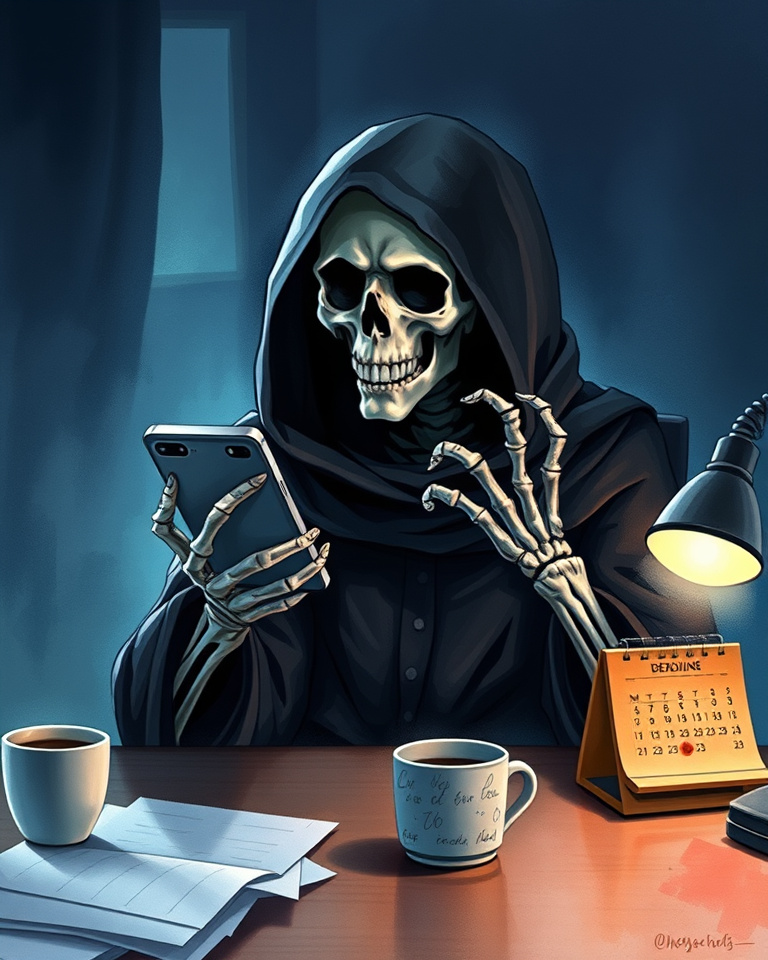
The Grim Reaper Left Me on Read
The Morbid Curiosity We All Pretend We Don’t Have
Am I the only one who occasionally wonders what people think in their final moments? No? Just me? Cool. There are times when it feels like I’m seeing more “Rest in Peace” posts online than usual, but maybe that’s just my brain selectively filtering out death like it’s some kind of pop-up ad I didn’t ask for. It’s funny (not ha-ha funny, more existential crisis funny) how we can go days, weeks, even months without thinking about death—until someone we know dies, and suddenly, we’re all amateur philosophers pondering the afterlife, or the lack thereof. Do they go somewhere? Do they just poof out of existence? Or are they suddenly playing an ultra-realistic game of Sims in another dimension?
Brain Matter Matters
The first time I saw a human brain, it wasn’t in a textbook. It had fallen out of a bomb blast victim. If that sentence just made you pause, imagine being me in that moment. There were body parts everywhere, but that brain. That stuck with me. Psychology tells us that memories tied to strong emotions—whether good or bad—stick. Well, let’s just say my brain was busy imprinting that image with all the permanence of a bad tattoo. And then I had the thought (because I can’t just be normal): if that brain were hooked up to a machine, would that person still be in there? If your brain could be downloaded like an external hard drive, would you live on? Or does death just wipe the whole thing like a factory reset?
Death, Denial & Dark Humour
I have a theory: we don’t fully understand death because it makes us deeply uncomfortable. If you know me personally, you know I joke about the most morbid things, but beneath the humor, there’s a weirdly serious undertone. Like, if I die, there will be sadness, sure—but who will actually grieve? Because of sadness and grief? Not the same thing. We all feel bad when someone dies. Cue the automatic “I’m so sorry for your loss.” But grieving? That’s a different beast. Grief is a long, messy, potentially lifelong process. It’s a full-blown emotional odyssey with more stages than a Broadway musical. Meanwhile, society treats loss like an awkward encounter—acknowledge it, murmur condolences, and then pretend it didn’t happen forty days later, especially in many African cultures. You bring up the deceased after the mourning period, and suddenly, you’re the one making things weird. But why? Death is literally the most natural thing in the world. Sad? Yes. But natural.
Grief Calculus: The Sadness Equation
Here’s a fun, slightly unhinged question I’ve asked my closest people at least once: How would you feel if I died? (If you haven’t, consider this your official warning). I think it a solid metric. The weight of someone’s absence tells you exactly how much they meant to you. Some people lose a parent and are devastated. Others? They lose nothing but a contact in their phone. Love and grief are deeply personal and sometimes wildly unequal. If you want to measure your importance in someone’s life, imagine your funeral and who’d be ugly crying versus who’d just be respectfully sad. If that makes you uncomfortable, congratulations, you’re normal.
The Departed: Not the Film, But Equally Hard to Process
One of my top 10 most-played songs is Dearly Departed by Marianas Trench. Fun fact: it’s not even about death. It’s about the end of a relationship, which, let’s be honest, feels like death. Also, one of my favourite movies is The Departed, though, after 10+ years, I still don’t fully understand what’s happening in it. But I digress. The point is, we should probably stop treating death like a shocking plot twist and start accepting that it’s the only spoiler we all definitely have coming. Instead of waiting until someone dies to post paragraphs about how much they meant to us, maybe we should love them loudly while they’re still here. Because one day, they won’t be. And maybe, just maybe, we should let people know how much their inevitable Grim Reaper rendezvous will ruin our lives before they take the walk.
Death: The Only Thing More Certain Than Taxes
If I had been raised in a different household, I probably would’ve studied thanatology—the scientific study of death—because I clearly have thoughts. But if you have encountered my mother, then you will understand that a career path would have been met with immediate disownment faster than you can say “morbid curiosity.”. So instead, here I am, analyzing why I refuse to put anything on a surface before wiping it down and why Captain America is my digital husband in Sims 4—but let’s be real, you’re judging me anyway. And that’s fine. Just don’t forget to tell your people you love them. Because whether we like it or not, we all have a one-way ticket to The Beyond, and none of us knows when it gets punched.
So, dear lovers, the next time you see a “Rest in Peace” post, take a moment. Think about the people you love. And maybe, just maybe, tell them how much they mean to you. Because life is short, but love? Love doesn’t have to be
